
Winning Through Deep-Tech Ecosystems
The Collaborative Engine Behind Breakthrough Innovation
Authored by Shalini Bartwal | Pallavi Marape

ASML, the Dutch company behind the world’s most advanced lithography systems, demonstrates that deep-tech innovation is rarely achieved by a single organisation. Its extreme ultraviolet lithography technology emerged from decades of collaboration with ZEISS, research institutions, chipmakers, governments, and specialised suppliers.
This reflects a broader shift in innovation: breakthrough technologies now depend on ecosystems that combine science, capital, policy, and industrial expertise. Competitive advantage increasingly lies not only in technological capability, but also in the ability to build and coordinate these ecosystems.
What this article establishes
Why ecosystems have become the new unit of competition instead of individual organizations.
How complementary players move technologies from lab to market.
The collaboration models behind the world's leading innovation hubs.
Why Singapore's ecosystem consistently outperforms expectations.
What today's leaders must rethink to compete in deep tech.
Innovation Through Collaboration
Deep-tech breakthroughs increasingly depend on ecosystems. No single organisation - however well-resourced or technically excellent - can independently span the full journey from scientific discovery to commercial deployment. The organisations that win are those that build and lead the ecosystems others depend on.
The New Unit of Competition
ASML’s story is not about one company but about a new model of innovation. The breakthroughs defining the future of semiconductors, biotechnology, clean energy, and quantum technologies are simply too complex for any single organisation to develop, finance, manufacture, and scale alone. As a result, competitive advantage no longer belongs solely to the organisation with the strongest technology. It belongs to the ecosystem that brings together the right capabilities, at the right time, to turn scientific discovery into commercial impact. In deep tech, ecosystems have become the new unit of competition.
Collaboration as a Strategic Capability
Organisations are no longer competing solely on the strength of their internal R&D. They are competing on their ability to connect with partners who bring knowledge, talent, capital, infrastructure, and industrial expertise the organisation does not have on its own. In this environment, collaboration is not an option but a strategic capability, one that determines how fast an idea moves and how far it eventually reaches. Deep-tech innovation therefore advances through interconnected networks, where different participants contribute at different stages of the journey, rather than through isolated internal effort. Understanding this model begins with understanding the ecosystem itself, and the distinct role each participant plays, setting the stage for the discussion that follows.
The Ecosystem in Action
The most resilient deep-tech ecosystems are not assembled - they are cultivated. They grow through trust, shared risk, and relentless focus on collective value creation.
From Discovery to Deployment
An innovation ecosystem is more than a collection of organisations; it is a network of complementary capabilities working toward a shared outcome. A breakthrough typically begins with scientific research at universities and research institutions, where new knowledge and intellectual property are created. Startups transform these discoveries into working technologies through experimentation and product development, while investors provide the patient capital long development cycles require. Governments strengthen the ecosystem by funding research, backing strategic initiatives, and building regulatory pathways. As innovations mature, established corporations bring industrial expertise, manufacturing capability, global supply chains, and market access - moving technologies out of the lab and into large-scale adoption. This is the same handoff, stage by stage, that carried EUV lithography from ASML’s labs to the fabs that now depend on it.
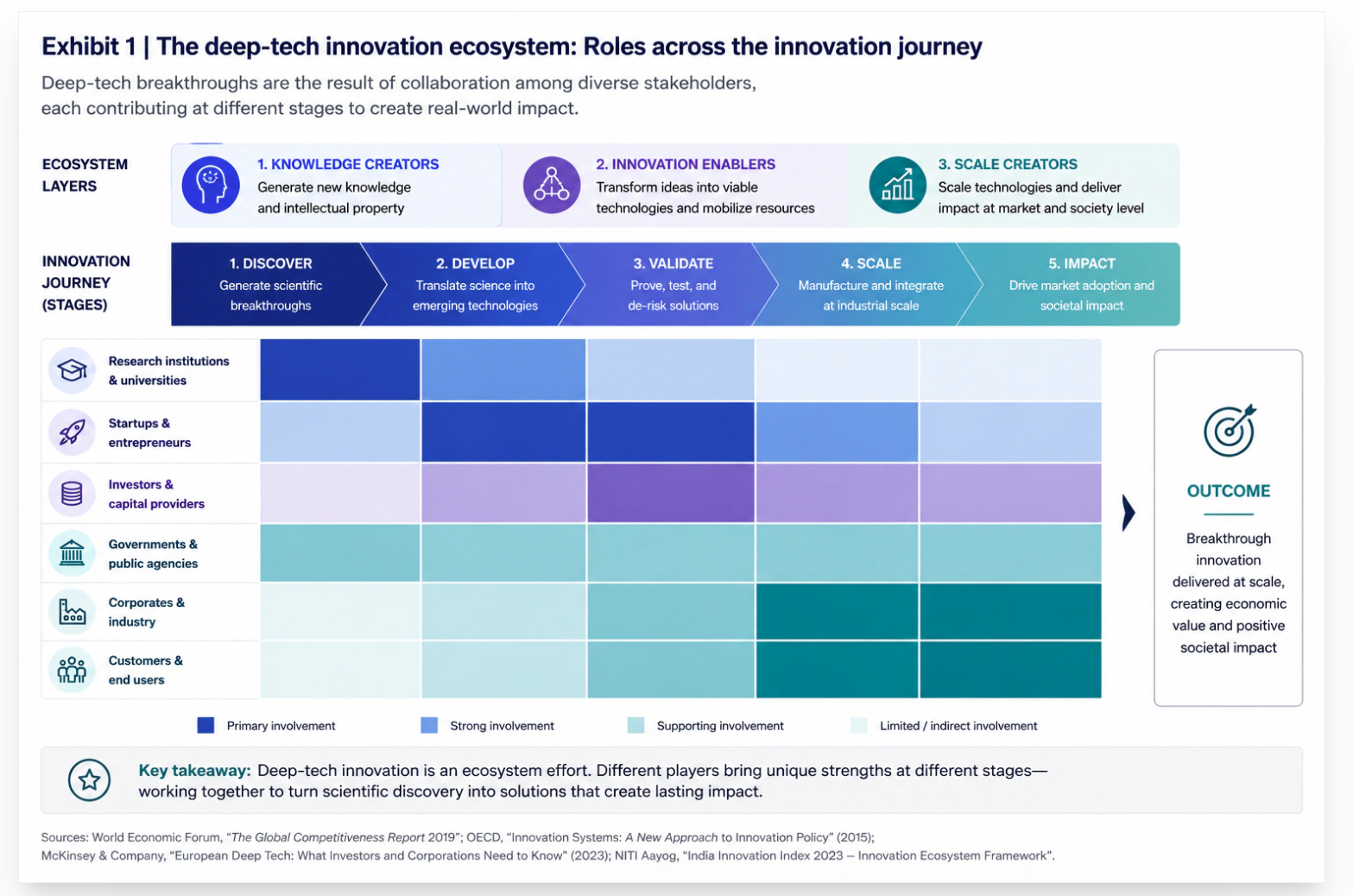
Exhibit 1. The Deep-Tech Innovation Ecosystem: Roles Across the Innovation Journey - deep-tech breakthroughs are the result of collaboration among diverse stakeholders, each contributing at different stages to create real-world impact.
Complementary Roles, Collective Value
These participants do not operate independently; they function as an interconnected system, where progress depends on continuous collaboration and shared resources. As Exhibit 1 shows, each stakeholder plays a distinct yet complementary role across the innovation journey, collectively forming an ecosystem more capable than any single organisation working alone. The strength of a deep-tech ecosystem lies not only in the excellence of its individual participants, but in the quality of the connections between them. These connections are what convert scientific discovery into economic value. Exhibit 1 illustrates how each participant contributes across different stages of the innovation journey, demonstrating that deep-tech breakthroughs emerge through complementary rather than isolated capabilities.
From Collaboration to Competitive Advantage
Collaboration as a Strategic Advantage
An ecosystem creates value not simply because diverse organisations coexist, but because they combine complementary capabilities to solve problems no single organisation could address alone. In deep tech, where uncertainty is high and development cycles often extend beyond a decade, collaboration enables organisations to distribute risk, access specialised expertise, and share the substantial investment required to bring breakthrough technologies to market. This need is reflected in industry data: BCG reports that deep-tech startups require approximately 48% more funding than conventional startups by the time they reach US$5 million in revenue, underscoring why collaborative funding and partnerships are essential rather than optional.
Four models recur across the ecosystems that do this well. Corporate-startup partnerships pair a large company’s scale and market access with a startup’s speed and technical focus. Public-private R&D consortia pool government and industry funding to de-risk early-stage research that no single investor would carry alone. University technology-transfer offices convert lab-based intellectual property into licensable, investable assets. And joint ventures combine capital, manufacturing capacity, and market access to take a technology the final distance to commercial scale. Each model moves knowledge and risk between participants in a different way, which is why the strongest ecosystems tend to run several in parallel, rather than relying on just one.
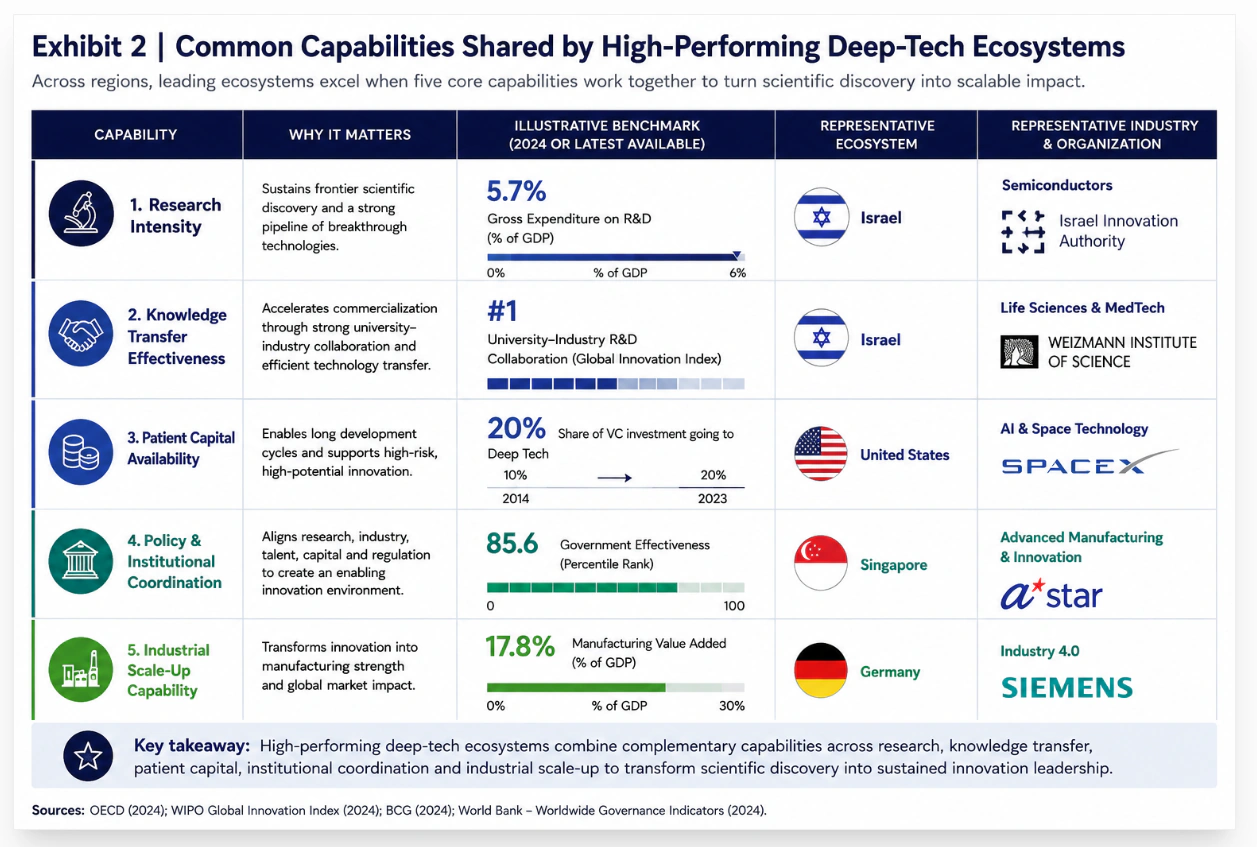
Exhibit 2. Capabilities that Distinguish High-Performing Deep-Tech Ecosystems - across regions, leading ecosystems excel when five core capabilities work together to turn scientific discovery into scalable impact.
Global Deep-Tech Ecosystem Landscape
Deep-tech ecosystems have become strategic engines of innovation, industrial competitiveness, and long-term economic growth. Around the world, leading ecosystems have evolved through different institutional structures, investment models, and industrial priorities, reflecting their unique economic and technological contexts. Yet, despite these differences, they demonstrate a common principle: breakthrough innovation flourishes when research institutions, industry, investors, governments, and entrepreneurs operate as an interconnected system. Examining these regional approaches provides valuable insight into how collaboration can be translated into sustained innovation leadership.
Bringing the Landscape Together
Although these regional ecosystems differ in their development pathways, they consistently demonstrate that deep-tech leadership is built by integrating complementary capabilities rather than relying on any single strength. High-performing ecosystems connect scientific research, knowledge transfer, patient capital, coordinated institutions, and industrial scale-up to accelerate the journey from discovery to commercial impact. Exhibit 2 synthesises the five capabilities that consistently distinguish high-performing deep-tech ecosystems, demonstrating how different regional models converge on the same foundations of innovation leadership.
Building Innovation that Lasts
Deep-tech breakthroughs may begin in laboratories, but lasting innovation is built through ecosystems. The world’s leading innovation hubs demonstrate that sustainable advantage does not come from scientific excellence, investment, or policy in isolation; it emerges when these capabilities are intentionally connected into systems that continuously generate, scale, and renew innovation. More importantly, the most successful ecosystems create a virtuous cycle in which every breakthrough attracts new talent, capital, partnerships, and investment, strengthening the ecosystem’s capacity to innovate again. Over time, the ecosystem itself becomes a strategic asset and a source of enduring competitive advantage.
For leaders, this demands a fundamental shift in perspective, moving from managing organisations to orchestrating interconnected networks. Building competitive advantage is no longer solely about strengthening internal capabilities; it is equally about creating the conditions that enable universities, startups, corporations, investors, governments, and research institutions to innovate together. Organisations that cultivate these connections will be better positioned to accelerate innovation, strengthen resilience, adapt to technological change, and capture long-term value.
Ultimately, the ecosystems that shape the future will not necessarily be those with the largest research budgets or the greatest number of startups. They will be those that continuously strengthen the connections between science, industry, capital, institutions, and talent, enabling each breakthrough to create the foundation for the next.
In deep tech, sustainable leadership is built not through isolated innovations, but through ecosystems that continuously renew their capacity to innovate.
ASML Holding N.V. (2024). Annual Report 2024. asml.com
BCG & Hello Tomorrow. (2017). What Deep-Tech Startups Want from Corporate Partners. bcg.com
Boston Consulting Group (BCG). (2024). Unlocking the Full Potential of Deep Tech. bcg.com
Carl Zeiss AG. Research & Development. zeiss.com
Harvard Business Review. (2019). What an Innovation Ecosystem Actually Is. hbr.org
McKinsey & Company. (2024). European Deep Tech: What Investors and Corporations Need to Know. mckinsey.com
Organisation for Economic Co-operation and Development (OECD). (2018). Oslo Manual 2018: Guidelines for Collecting, Reporting and Using Data on Innovation (4th Edition). oecd.org
Organisation for Economic Co-operation and Development (OECD). (2024). Main Science and Technology Indicators (MSTI). oecd.org
Singapore Economic Development Board (EDB). Powering Singapore’s Innovation Economy. edb.gov.sg
Startup Genome. (2024). Global Startup Ecosystem Report 2024. startupgenome.com
United Nations Development Programme (UNDP). (2025). Global Deep Tech Ecosystems: Catalyzing Innovation for Sustainable Development. undp.org
World Bank. World Development Indicators. databank.worldbank.org
World Economic Forum (WEF). (2024). The Global Cooperation Barometer 2024. weforum.org
World Intellectual Property Organization (WIPO). (2024). Global Innovation Index 2024. wipo.int
Need clarity on a deep-tech ecosystem challenge?
Start a conversation with ESIQ about your research needs - from ecosystem mapping to competitive intelligence and market entry strategy.
Continue the research

Beyond the Breakthrough: Commercializing Deep Tech
Scientific breakthroughs alone do not create industry leaders. This article explores why commercialization has become the decisive capability that turns deep-tech innovation into scalable business value.
Read More →
Beyond Innovation: The Business of Scaling Deep Tech
A comprehensive market report on Deep Tech size, dynamics, segmentation, investment patterns, policy signals, regional ecosystems, and future outlook.
Read More →