
Beyond the Breakthrough: Commercializing Deep Tech
Transforming Scientific Discovery into Market Leadership Through Strategic Commercialization
Authored by Shalini Bartwal | Pallavi Marape

Imagine Tesla had built an exceptional electric vehicle but never invested in charging infrastructure, manufacturing scale, or customer confidence. Or imagine OpenAI had developed powerful foundation models but never made them accessible through ChatGPT or enterprise APIs. Their technologies would still have been groundbreaking. Their market impact would have been marginal. This is the defining challenge of deep tech.
Scientific breakthroughs create value only when successfully commercialised. In deep tech, competitive advantage depends on building ecosystems, navigating regulation, creating demand, and scaling innovation into market-leading businesses.
What this article establishes
Commercialization is the true driver of deep-tech success, beyond invention.
Market leadership is built through ecosystems, scale, and customer adoption.
Strategic commercialization transforms breakthrough innovation into lasting business value.
Why breakthroughs alone are not enough
Scientific breakthroughs alone do not create industry leaders. The history of deep technology is littered with transformative discoveries that never reached commercial scale - not because the science failed, but because the path from laboratory to market was never navigated successfully.
The Distinct Nature of Deep Tech
Unlike conventional digital innovations, deep technologies are rooted in scientific and engineering breakthroughs that require years of research, significant capital investment, specialised infrastructure, and rigorous validation before reaching the market. Technologies such as artificial intelligence, quantum computing, biotechnology, advanced materials, and robotics face long development cycles, regulatory complexity, and high technical uncertainty as a matter of course, not exception.
Industry research puts numbers to this reality: deep-tech ventures typically require development cycles of five to ten years or more - significantly longer than conventional software startups - while also requiring greater upfront investment and closer collaboration across industry, academia, investors, and governments. These characteristics make commercialization more difficult, and strategically more consequential, than the invention itself. Patient capital and long-horizon strategic planning are not optional extras for deep tech; they are the operating model.
Crossing the Commercialization Gap
For most organisations, the hardest work begins after the technology has been proven. Prototypes and pilot projects demonstrate technical feasibility. They do not guarantee commercial success. The transition from validation to large-scale market adoption - commonly referred to as the commercialization gap - is where the majority of promising innovations lose momentum. Organisations must simultaneously secure investment, establish manufacturing capability, navigate regulatory pathways, build strategic partnerships, and create customer demand, often with no single function owning all five. The defining question for business leaders is no longer “Can this technology work?” It is “Can this technology create sustainable business value at scale?”
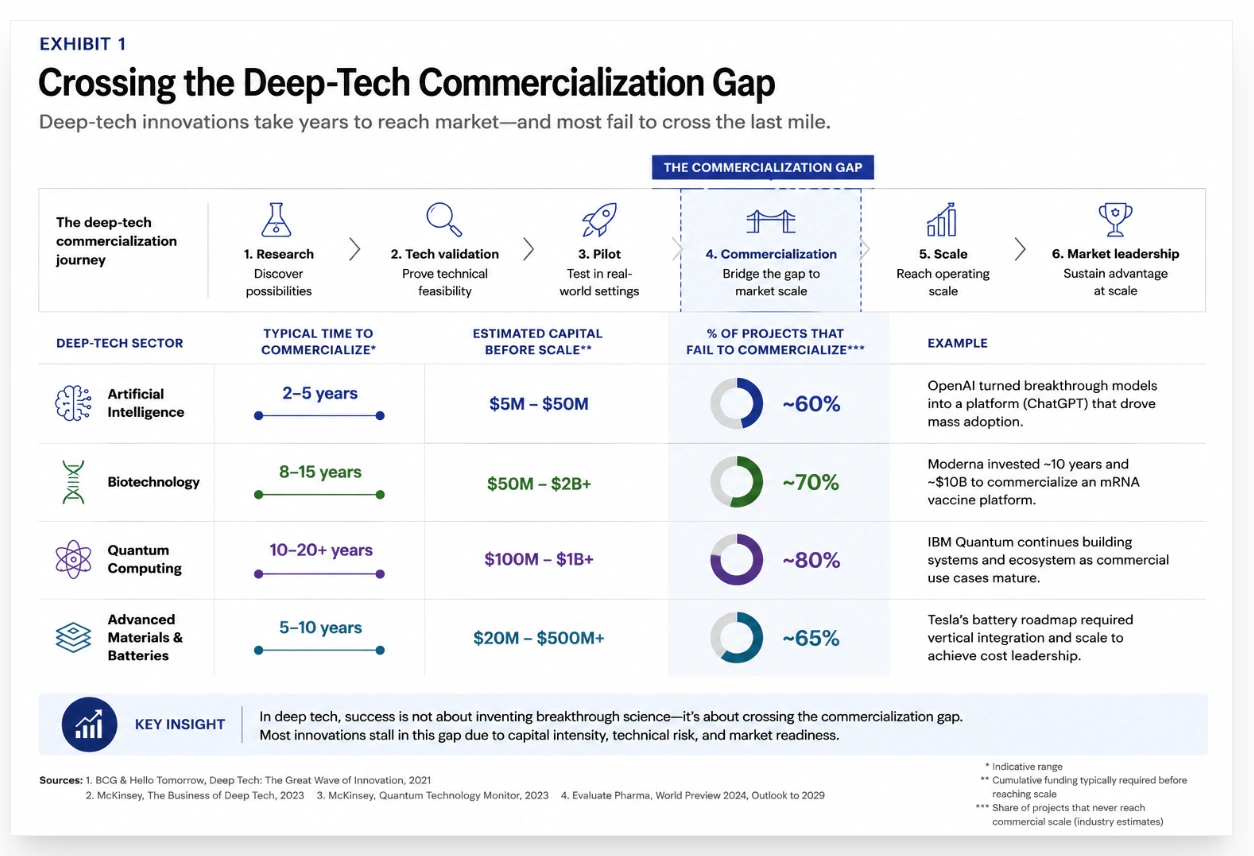
Exhibit 1. Crossing the Deep-Tech Commercialization Gap - as the complexity of commercialization varies across deep-tech sectors, the underlying barriers to scale remain remarkably consistent: capital intensity, regulatory friction, and the absence of an established customer base.
Building Markets, Not Just Products
The most successful deep-tech companies are not just technology developers - they are market architects who shape the conditions for their own adoption.
Creating Demand before Creating Scale
Commercial success begins long before large-scale production. Technological readiness determines whether an innovation performs as intended. Market readiness determines whether customers are willing to adopt it - yet the two are rarely developed on the same timeline. Organisations that commercialize deep tech successfully treat market readiness as a workstream in its own right: they focus on solving high-value business problems, demonstrating measurable outcomes, and systematically reducing adoption barriers from the earliest stages of the innovation journey.
This requires more than product development. It requires educating customers, validating use cases, establishing trust, and integrating new technologies into existing business processes. OpenAI’s rapid adoption curve with ChatGPT was driven not only by advances in foundation models, but by making that technology accessible through intuitive interfaces and enterprise-ready APIs. The lesson for any deep-tech leader: adoption accelerates in direct proportion to how easy an innovation is to access, understand, and apply. Complexity that is invisible to the user is an asset; complexity the user has to manage is a tax on adoption.
Building an Ecosystem that Scales
No deep-tech company commercializes innovation alone. Unlike traditional products, deep-tech solutions depend on a network of complementary capabilities, including suppliers, manufacturers, investors, regulators, research institutions, technology partners, and customers. These stakeholders collectively absorb commercialization risk and accelerate market adoption in ways no single organisation can replicate internally.
The rapid growth of the electric vehicle industry illustrates the principle precisely. Market expansion was enabled not only by advances in battery technology, but by parallel investment in charging infrastructure, manufacturing capacity, supply chains, supportive policy, and strategic partnerships across the value chain. None of these moved in sequence; they moved together, deliberately coordinated. In deep tech, competitive advantage is created through ecosystem orchestration, not technological superiority in isolation.
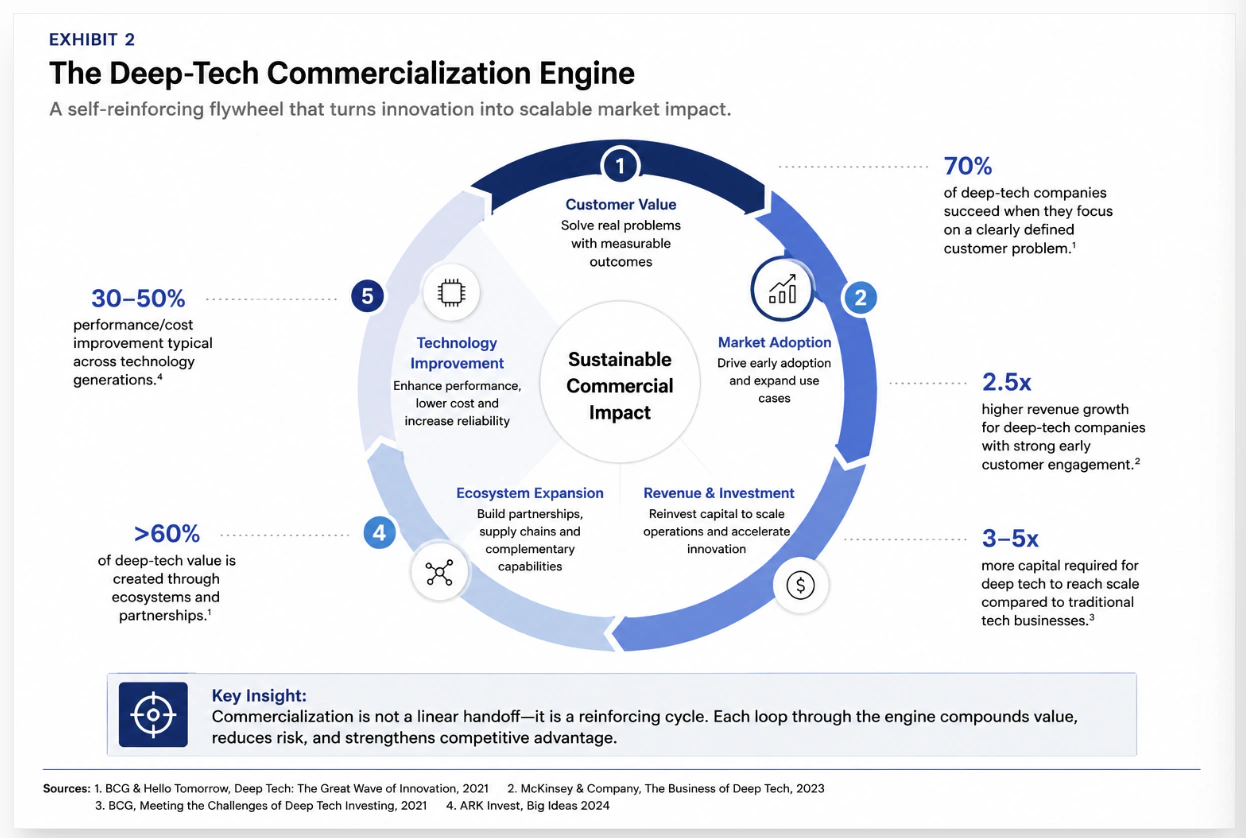
Exhibit 2. The Deep-Tech Commercialization Engine - successful commercialization creates a self-reinforcing cycle in which customer adoption, ecosystem expansion, and continuous innovation compound into long-term competitive advantage.
Scaling the Business, Not Just the Technology
As technologies move from pilot to commercial deployment, organisational capability becomes as decisive as scientific capability. Scaling demands resilient operations, reliable manufacturing, sustained investment, and governance frameworks built to adapt as market conditions shift. Without this operating foundation, even technically superior innovations stall well short of commercial impact. Organisations that align technology development with customer demand, ecosystem collaboration, and scalable business models convert breakthrough discoveries into sustainable growth far more consistently than those that treat commercialization as an afterthought. The companies that shape future industries will be those that build markets, not simply better technologies.
Leading the Next Wave of Deep-Tech Commercialization
Commercialization as a Leadership Imperative
As deep technologies continue to reshape industries, commercialization must evolve from a downstream function into a boardroom priority. The organisations that lead the next decade will not necessarily be those with the most advanced technology, but those that consistently convert scientific breakthroughs into scalable businesses. That requires leaders to hold long-term innovation and commercial discipline simultaneously, ensuring technology development stays continuously aligned with customer need, market readiness, and business objective - rather than optimised for a single one at the expense of the others.
Building for Sustainable Market Leadership
Successful commercialization demands more than technical excellence. It requires organisations to orchestrate ecosystems, invest in scalable operating models, and build capabilities that extend well beyond research and development. Strategic partnerships, regulatory engagement, manufacturing readiness, and customer adoption belong on the same priority list as the technology roadmap - core business priorities rather than sequential activities to be addressed once the science is settled.
For CEOs and CXOs, the strategic question has already shifted. It is no longer whether to invest in deep tech, but how to commercialize it effectively once the investment is made. Organisations that build commercialization into their innovation strategy from day one reduce risk, accelerate market adoption, and create competitive advantage that compounds rather than resets with every new technology cycle.
Deep tech has the potential to redefine industries, transform economies, and address some of the world’s most pressing challenges. Yet history consistently demonstrates that technological breakthroughs alone rarely create lasting market leaders.
The Future Belongs to the Commercializers
From healthcare and clean energy to advanced manufacturing and intelligent automation, deep tech’s impact is already beginning to reshape the global economy. Sustainable success belongs to organisations that bridge the gap between innovation and commercialization by combining scientific excellence with strategic execution. For business leaders, commercialization should no longer be viewed as the final stage of innovation but as a strategic capability that is embedded throughout the innovation journey. Organisations that integrate market validation, ecosystem development, customer adoption, regulatory readiness, and scalable operating models from the outset will be better positioned to reduce uncertainty, accelerate adoption, and create long-term value.
In the decade ahead, the organisations that define industries will not simply be those that invent breakthrough technologies, but those that commercialize them with speed, scale, and strategic intent. As deep tech continues to reshape the global economy, competitive advantage will increasingly belong to organisations that treat commercialization not as the final step of innovation, but as the capability that transforms breakthrough science into lasting business and societal value.
Boston Consulting Group (BCG). (2021). Deep Tech and the Great Wave of Innovation. bcg.com/publications/2021/deep-tech-innovation
Boston Consulting Group (BCG) & Hello Tomorrow. (2021). Deep Tech: The Great Wave of Innovation. hello-tomorrow.org/deep-tech-the-great-wave-of-innovation
Gartner. (2024). Hype Cycle for Emerging Technologies 2024.
International Energy Agency (IEA). (2024). Global EV Outlook 2024.
McKinsey & Company. (2024). European Deep Tech: What Investors and Corporations Need to Know. mckinsey.com
McKinsey & Company. (2025). Europe’s Deep-Tech Engine Could Spur $1 Trillion in Economic Growth. mckinsey.com
McKinsey & Company. (2025). Technology Trends Outlook 2025. mckinsey.com
OECD. (2023). OECD Science, Technology and Innovation Outlook 2023.
World Economic Forum. (2025). The Future of Jobs Report 2025.
World Intellectual Property Organization (WIPO). (2024). World Intellectual Property Indicators 2024.
Need clarity on a deep-tech commercialization challenge?
Start a conversation with ESIQ about your research needs - from technology intelligence to market entry and competitive mapping.
Continue the research

Winning Through Deep-Tech Ecosystems
Deep-tech breakthroughs increasingly depend on ecosystems that connect scientific excellence, patient capital, policy, industrial expertise, and market access.
Read More →
Beyond Innovation: The Business of Scaling Deep Tech
A comprehensive market report on Deep Tech size, dynamics, segmentation, investment patterns, policy signals, regional ecosystems, and future outlook.
Read More →