
Climate Finance: Powering the Global Energy Transition
Navigating the trillion-dollar shift - accelerating capital realignment for the climate transition.
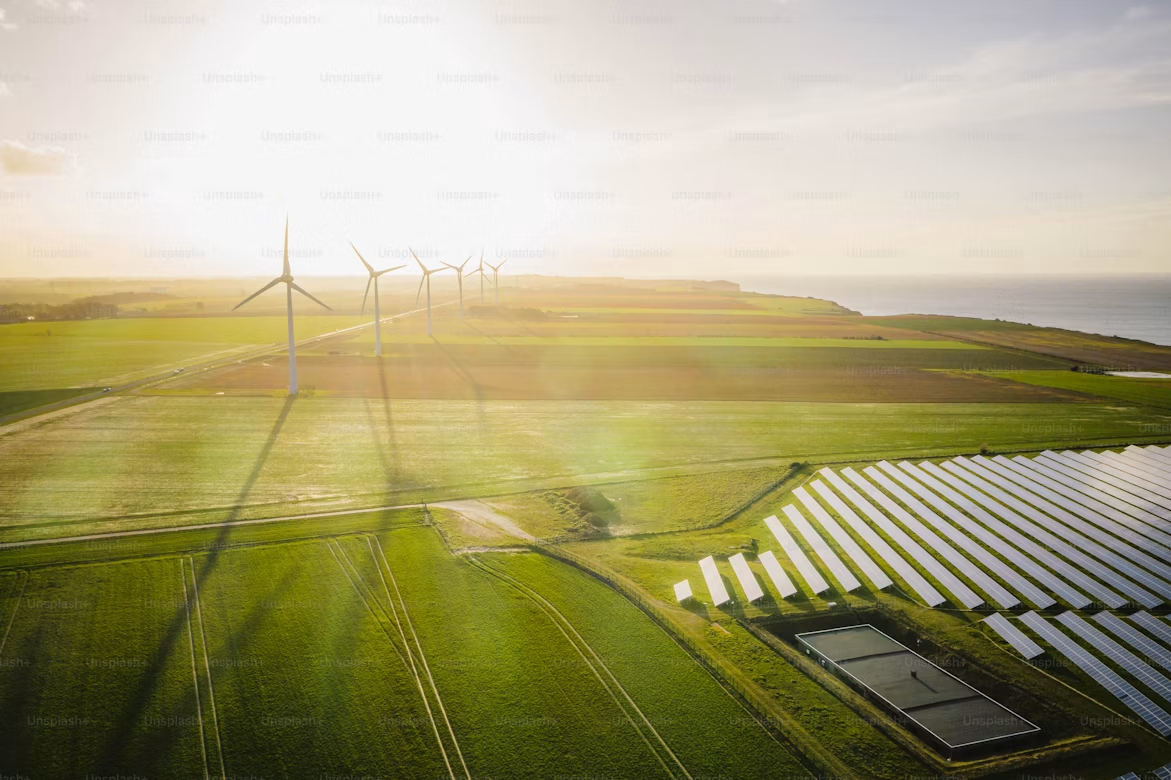
Climate finance stands at a critical juncture in 2026. Global flows have surpassed USD 2 trillion annually for the first time, yet the gap between current investment and what is needed to meet climate and development goals continues to widen. The international community has set ambitious new targets, notably the New Collective Quantified Goal (NCQG) of at least USD 300 billion per year in international climate finance by 2035, with a broader call to mobilize at least USD 1.3 trillion annually for developing countries from all sources. However, the composition, effectiveness, and accessibility of climate finance remain under scrutiny, especially for vulnerable economies.
Global climate finance has crossed USD 2 trillion but remains insufficient.
Climate finance is now central to investment and risk management.
Clean energy investment is growing faster than fossil-fuel investment.
Green bonds, loans, and blended finance are mobilising private capital.
Better policies and reporting are needed to close the financing gap.
Climate finance: beyond funding climate projects
Climate finance has evolved from a niche asset class into a foundational pillar of modern global macroeconomic strategy. From a consulting perspective, climate finance is no longer merely about carving out ring-fenced budgets for standalone environmental projects like wind farms or solar installations. Instead, it represents the systemic reconfiguration of the global financial architecture to achieve two deeply intertwined goals: scaling up low-carbon solutions and systematically managing the transition of carbon-intensive industries (OECD, 2026). True alignment requires looking beyond current balance sheets to evaluate shifting corporate business models, capital expenditure (CapEx) pipelines, and long-term economic resilience. As institutional frameworks mature, climate finance acts as a bridge between real-economy climate policies and capital markets, translating environmental imperatives into measurable financial risk and return metrics (CPI, 2026).
From global commitments to trillion-dollar investments
The trajectory of climate finance marks a clear shift from voluntary pledges to institutionalized, multi-trillion-dollar frameworks. Under Article 2.1c of the Paris Agreement, the mandate is clear: make all financial flows consistent with a pathway toward low greenhouse gas (GHG) emissions and climate-resilient development (UNFCCC, 2016). Between 2000 and 2025, policy interventions accelerated sharply, with authorities across 111 countries and the European Union adopting more than 860 climate-related financial sector policies (OECD, 2026). This regulatory push has been accompanied by a shift in governance. Central banks, which historically sat on the sidelines of environmental policy, have taken an active role, accounting for 32% of all climate-related financial policies implemented globally by 2025, surpassing individual financial supervisors (28%) and national ministries (28%) (OECD, 2026). While initial policy playbooks relied primarily on voluntary frameworks, modern architecture is firmly anchored in mandatory, market-wide standards designed to mitigate systemic transition risks and combat greenwashing.
2000-2025
Exhibit 1. Distribution and share of the global financial policy mix (2000-2025). Source: OECD.
A toolkit that has outgrown the green bond
To match the scale of the transition, the financial sector has expanded its toolkit far beyond traditional green bonds. The modern climate toolkit relies on structural innovation across multiple asset classes:
Clean energy is outpacing fossil fuels - but not everywhere
An analysis of global capital allocation reveals a positive macro trend: clean energy investments are outpacing fossil fuels by their widest margin to date. In 2024, global investments in low-carbon energy accounted for 7% of gross fixed capital formation (GFCF), comfortably beating fossil-fuel supply investments at 4% (OECD, 2026). However, it reveals a persistent, troubling disconnect between the real economy and the financial system's broader asset classes:
Exhibit 2. Global low-carbon vs. carbon-intensive capital flows. Low-carbon energy leads on supply investment, but still trails in corporate bond stock and syndicated loans. Source: OECD, CPI.
Exhibit 3. Global climate finance by sector, 2019-2024 (USD billions). Source: OECD, CPI.
Climate finance remains heavily concentrated in three sectors: energy systems (48%), transport (25%), and buildings and infrastructure (18%). Investment growth has been strongest in energy and transport, driven by the rapid deployment of renewable energy technologies and electric vehicles. In contrast, buildings and infrastructure have witnessed comparatively slower growth due to rising construction costs and weaker investment pipelines. These trends indicate that climate finance continues to prioritize sectors with high emissions-reduction potential and mature, scalable technologies.
Four bottlenecks standing between ambition and capital
Corporate leaders and policymakers must address several systemic bottlenecks to convert climate goals into deployable investments.
Harmonizing the transparency playbook
A major barrier for multinational corporations is the lack of alignment between corporate disclosures and financial-institution reporting. With the rapid transition from old TCFD pillars to the mandatory International Sustainability Standards Board (ISSB/IFRS S2) standards, firms face fragmented compliance costs (ISSB, 2023). Bridging the gap requires national authorities to implement unified, machine-readable reporting templates that cover both listed giants and opaque private-equity portfolios (OECD, 2026).
Evolving from risk mitigation to opportunity metrics
Historically, climate-finance metrics have focused on backward-looking GHG emission indicators. Consulting firms emphasize that to unlock capital at scale, the narrative must pivot toward forward-looking, opportunity-centric metrics, such as green revenue shares of portfolio firms, CapEx alignment with credible sector-specific transition pathways, and the progressive integration of physical climate risk and adaptation metrics into corporate transition plans (OECD, 2026).
Resolving the prudential trade-off
A core dilemma faces central banks and supervisors: implementing aggressive prudential rules, like a brown-penalising factor, creates a tough policy trade-off. While it successfully reduces a bank's exposure to climate risks, it can trigger sudden credit contractions and defaults in vital economic sectors, threatening near-term financial stability (OECD, 2026). Supervisors must balance these penalties with positive reinforcing measures, like targeted green-credit operations and expanded climate stress testing.
Eradicating subsidies for distorted market signals
From an economist's perspective, real-economy financial incentives remain heavily distorted. Ongoing public subsidies for fossil-fuel production and consumption directly undermine the net present value (NPV) and internal rate of return (IRR) models of clean-energy investments (OXFAM, 2025). Financial regulations cannot operate in a vacuum; without reforming these fiscal policies, private capital will naturally continue to flow toward artificially supported, carbon-intensive operations.
From compliance exercise to core strategy
The next phase of global climate finance will be defined by the integration of policy frameworks and market ingenuity. Financial institutions can no longer treat climate alignment as a compliance or corporate social responsibility (CSR) exercise. It must be woven directly into core asset allocation, underwriting, and risk-management strategies.
For governments and supervisors, the mandate is to broaden the policy mix beyond mere disclosure rules. This means designing investable national climate plans, scaling up public transition debt, and leveraging advanced data tools such as geospatial imaging and natural language processing (NLP) to validate corporate claims and protect market integrity (OECD, 2026). Capital is ready to move; the challenge now lies in engineering the pathways that allow it to flow efficiently, safely, and globally.
Capital is ready to move; the challenge now lies in engineering the pathways that allow it to flow efficiently, safely, and globally.
International Sustainability Standards Board (ISSB). (2023). IFRS S2 Climate-Related Disclosures. London: IFRS Foundation.
OECD. (2026). Climate Club Financial Toolkit 2026 Update: Economic, De-risking and Financing Instruments for Industry Decarbonisation. Paris: OECD Publishing.
OECD. (2026). Climate Finance Provided and Mobilised by Developed Countries in 2013-2024. Paris: OECD Publishing.
OECD. (2026). OECD Review on Aligning Finance with Climate Goals 2026: Different Policy Playbooks, Untapped Investment Opportunities. Paris: OECD Publishing.
OPEC Fund for International Development. (2025). Climate Finance Report 2025. Vienna: OPEC Fund.
OXFAM. (2025). Climate Finance Shadow Report 2025. Oxford: Oxfam GB.
Sasha Abraham, P. d. (2026). Global Landscape of Climate Finance 2026. CPI.
United Nations Framework Convention on Climate Change (UNFCCC). (2016). The Paris Agreement. New York: UNFCCC secretariat.
Research built for climate finance decisions
ESIQ provides bespoke intelligence, market mapping, and voice-of-customer research for organisations navigating the climate finance and energy transition landscape - whether as financial institutions, corporates, investors, or policymakers.
Policy & Regulatory Intelligence
Tracking climate finance policy, disclosure standards and prudential frameworks as they evolve across central banks, supervisors and national authorities.
Capital Flow & Investment Mapping
Mapping climate finance flows by sector, instrument and geography - identifying where capital is moving fastest and where financing gaps persist.
Financial Instrument Benchmarking
Benchmarking green bonds, transition bonds, sovereign issuance and blended-finance structures - pricing, uptake and market positioning.
Competitive & Market Landscape Analysis
Profiling financial institutions, MDBs and market participants shaping the climate finance ecosystem, and where new entrants can compete.
Voice of Customer Research
Understanding what institutional investors, issuers and corporates require from climate-aligned financial products and reporting frameworks.
Strategic Advisory & Market Entry
Supporting investment, product design and market-entry decisions for organisations operating across the climate finance value chain.
Realigning capital for the climate transition?
ESIQ partners with financial institutions, corporates and policymakers to turn climate ambition into investable, decision-grade strategy - from disclosure through deployment.
Continue the research

Marine Shipping Decarbonisation
Navigating the transition to low-carbon shipping - the regulations, fuels, infrastructure and freight economics reshaping global trade.
Read More →
Cement Decarbonisation & Green Cement Solutions
The levers, technologies and economics reshaping one of the world's hardest-to-abate industrial sectors - and the commercial case for low-carbon construction.
Read More →